

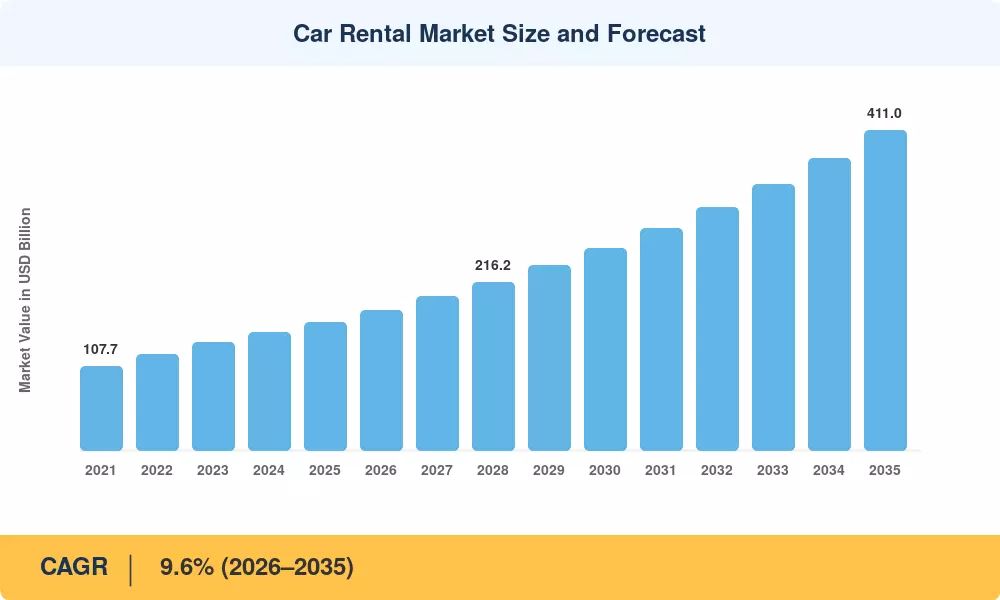
Car Rental Market to Reach USD 411 Billion by 2035, Growing at 9.6% CAGR
Car Rental Market
Online platforms are forecast to expand at an 11.2% CAGR during 2026–2035, outpacing the overall market as mobile-app penetration deepens in emerging economies
Offline booking channels commanded a 58.0% share of the Car Rental Market in 2025, reflecting continued traveler reliance on airport counters and travel-agency bundled packages”
NEW YORK, NY, UNITED STATES, August 27, 2026 /EINPresswire.com/ -- According to Market Research Future, the Car Rental Market is projected to reach USD 180.00 billion in 2026 before climbing to USD 411.00 billion by 2035, registering a CAGR of 9.6% across the 2026–2035 period, with growing market share being fueled by major players. This impressive growth trajectory reflects the fundamental transformation occurring within the mobility sector, where traditional car rental models are evolving into comprehensive, technology-enabled transportation solutions that cater to changing consumer preferences, urbanization trends, and the increasing demand for flexible mobility options.— Swapnil Palwe
Market Overview
The car rental market encompasses a wide range of services that provide vehicles to customers for short-term or long-term usage without requiring ownership. This includes traditional rental agencies, peer-to-peer car sharing platforms, corporate fleet leasing, and chauffeur-driven services that cater to diverse customer segments ranging from leisure travelers to business professionals and daily commuters. The market has undergone significant evolution from conventional counter-based rental operations to digitally enabled platforms that offer seamless booking, contactless pickups, and real-time vehicle tracking.
The key growth drivers propelling this market expansion include the rising urbanization and increasing population density in major cities worldwide, which has led to growing acceptance of shared mobility solutions as viable alternatives to private vehicle ownership. The tourism and hospitality sector's robust recovery following the pandemic has substantially boosted demand for rental vehicles, particularly in popular leisure destinations. Corporate travel and business mobility requirements continue to generate steady demand, with organizations opting for rental solutions to manage their transportation needs efficiently. Additionally, the growing preference for flexible mobility options among millennials and Gen Z consumers, who prioritize access over ownership, is significantly contributing to market growth.
Technological developments are reshaping the car rental landscape at an accelerating pace. Mobile applications and digital platforms have revolutionized the booking experience, enabling customers to compare prices, select vehicles, complete documentation, and manage rentals entirely through smartphones. The integration of artificial intelligence and machine learning algorithms is enabling dynamic pricing models, predictive demand forecasting, and personalized recommendations that enhance customer experience and operational efficiency. Telematics and IoT-enabled vehicle tracking systems are improving fleet management, enabling real-time vehicle monitoring, predictive maintenance, and optimized utilization rates.
📍 Get Free Sample Report for Detailed Market Insights:
https://www.marketresearchfuture.com/sample_request/6409
Market Segmentation
The car rental market is segmented based on booking mode, application, end user, vehicle type, rental length, and regional analysis to provide comprehensive insights into the industry landscape.
By Booking Mode: The market is categorized into Offline and Online booking channels. Online booking has emerged as the dominant segment, accounting for the majority share as consumers increasingly prefer the convenience, transparency, and comparative shopping capabilities offered by digital platforms. Mobile applications and websites enable customers to browse vehicle options, view real-time availability, compare pricing, complete bookings, and manage modifications seamlessly. The integration of digital payment systems, identity verification, and digital documentation has further streamlined the online booking experience, reducing friction and enhancing customer satisfaction. Offline booking through physical rental counters, travel agencies, and phone reservations continues to serve specific customer segments, particularly in emerging markets and among older demographics who prefer traditional channels.
By Application: The market is divided into Leisure and Business applications. The leisure segment dominates the market, driven by tourism activities, vacation travel, weekend getaways, and special occasions. Leisure renters typically seek vehicles that accommodate their travel needs, ranging from compact cars for city exploration to SUVs and vans for family vacations and group travel. The business segment represents a significant and growing share, encompassing corporate travel, employee transportation, client meetings, and event logistics. Business renters prioritize reliability, convenience, and efficiency, often utilizing loyalty programs and corporate accounts to streamline the rental process. The integration of business travel management platforms and expense management tools is enhancing the corporate rental experience.
By End User: The market serves three primary user categories: Self-Drive Individuals, Chauffeur-Driven customers, and Peer-to-Peer Hosts. Self-drive individuals represent the largest segment, comprising leisure travelers, business professionals, and daily commuters who prefer the independence and flexibility of driving themselves. Chauffeur-driven services cater to corporate executives, luxury travelers, and special occasion customers who value convenience, comfort, and professional driving services. Peer-to-peer hosts have emerged as a growing segment, enabled by platforms that allow individuals to rent their personal vehicles to others, creating a sharing economy ecosystem that expands vehicle availability and offers unique rental experiences.
By Vehicle Type: The market encompasses Mini & Economy Cars, Compact & Intermediate Cars, SUVs & MPVs, Luxury & Premium vehicles, and Vans & Commercial vehicles. Economy and compact cars dominate in terms of volume, driven by cost-conscious leisure travelers and urban mobility needs. SUVs and MPVs are witnessing growing demand as families and group travelers seek spacious, versatile vehicles for vacations and road trips. The Auto Leasing Service Market has seen parallel growth, with businesses and individuals increasingly opting for long-term leasing arrangements as an alternative to traditional car rental for extended usage periods. Luxury and premium vehicles cater to the high-end segment, serving business executives, luxury travelers, and special occasion customers. Vans and commercial vehicles address the transportation needs of large groups, moving services, and small business logistics.
By Rental Length: The market is segmented into Short-Term rentals (1–7 days), Medium-Term rentals (8–30 days), and Long-Term rentals (31+ days). Short-term rentals dominate the market, driven by tourism, business travel, and occasional mobility needs. Medium-term rentals serve customers with extended travel requirements, such as business project assignments, prolonged vacations, and temporary transportation needs. Long-term rentals cater to customers requiring vehicles for several months, including expatriates, insurance replacement, and temporary vehicle needs, often serving as an alternative to traditional leasing and ownership.
By Region: The market analysis covers North America, Europe, South America, Asia Pacific, and the Middle East and Africa, providing comprehensive geographic insights into regional dynamics and growth opportunities.
🛒 You can buy this market report at:
https://www.marketresearchfuture.com/checkout?currency=one_user-USD&report_id=6409
Regional Analysis
North America represents one of the largest and most mature car rental markets globally, characterized by high vehicle penetration, strong tourism activity, and widespread acceptance of rental services. The United States dominates the regional market, with major rental companies operating extensive networks across airports, urban centers, and tourist destinations. The robust corporate travel sector, combined with strong domestic tourism, continues to drive steady demand. The growing popularity of outdoor recreation and road trips among American consumers is supporting demand for SUVs, vans, and specialty vehicles. The Canadian market is witnessing growth driven by tourism, particularly in popular destinations like Vancouver, Toronto, and the Rocky Mountain regions, along with increasing adoption of car sharing and mobility solutions.
Europe constitutes another major market, with diverse rental landscapes across countries and regions. Western European markets like Germany, France, the United Kingdom, Italy, and Spain are well-established, driven by strong tourism inflows, business travel, and well-developed transportation infrastructure. The European market is characterized by high environmental awareness, driving demand for electric and hybrid rental vehicles. Southern European destinations, popular for summer vacations, experience seasonal demand peaks, while Northern European markets show more consistent year-round activity. The expanding Vehicle Subscription Market is particularly notable in Europe, where consumers are increasingly embracing flexible mobility solutions that offer vehicle access without long-term commitment.
Asia Pacific emerges as the fastest-growing regional market, fueled by rapid urbanization, expanding middle-class populations, and rising tourism activity across the region. China leads the region with enormous domestic travel volumes and growing business travel, with major players investing heavily in digital platforms and fleet expansion. India represents a high-growth market driven by improving road infrastructure, rising disposable incomes, and growing tourism and business travel. Japan and South Korea are mature markets with sophisticated rental ecosystems and high technology adoption, including advanced booking systems and vehicle tracking. Southeast Asian nations like Thailand, Malaysia, and Indonesia are witnessing rapid growth driven by tourism recovery and increasing domestic travel.
South America presents significant growth potential, with Brazil leading the region driven by business travel, domestic tourism, and improving economic conditions. The region faces challenges including infrastructure limitations, economic volatility, and complex regulatory environments, but growing urbanization and rising tourism are positive factors. Argentina, Colombia, and Chile are emerging as growing markets with expanding rental networks and increasing adoption of digital booking platforms.
The Middle East and Africa represent diverse markets with varying levels of maturity. The Middle East, particularly the UAE, Saudi Arabia, and Qatar, shows strong demand driven by business travel, luxury tourism, and major events and exhibitions. The Gulf region is attracting significant investment in premium and luxury rental fleets to cater to the high-end tourism segment. African markets are at varying stages of development, with South Africa leading the region, followed by growing markets in Kenya, Nigeria, and Morocco, where urbanization and tourism development are driving rental demand.
Competitive Landscape and Key Players
The car rental market is highly competitive, featuring a mix of global corporations, regional players, and emerging digital-native platforms competing for market share. The competitive landscape is characterized by fleet expansion, technology investment, strategic partnerships, and service innovation.
Key players operating in this market include Enterprise Holdings, Hertz Corporation, Avis Budget Group, Europcar Mobility Group, Sixt SE, Alamo, National Car Rental, and local and regional operators across various markets. These industry leaders are investing heavily in digital transformation, expanding their electric vehicle fleets, and developing integrated mobility solutions that go beyond traditional car rental.
Strategic developments are reshaping the competitive landscape significantly. Major players are forming partnerships with automotive manufacturers to secure EV supply and build charging infrastructure. Collaborations with travel technology platforms, hotel chains, and airlines are creating integrated travel ecosystems that streamline booking and enhance customer convenience. The Vehicle Subscription Market has emerged as a key strategic area, with major rental companies launching subscription services that offer customers vehicle access through all-inclusive monthly fees, providing an attractive alternative to traditional ownership and long-term leasing.
Innovation and technology initiatives are accelerating across the industry. Companies are implementing AI-powered customer service systems, advanced fleet management software, and dynamic pricing algorithms to optimize operations and enhance profitability. The integration of connected vehicle technologies enables real-time diagnostics, predictive maintenance, and improved utilization tracking. Mobile apps are becoming comprehensive mobility platforms, offering booking, payment, digital key access, and customer support functionalities.
Sustainability initiatives are gaining prominence, with leading players committing to fleet electrification, carbon offset programs, and sustainable operations. The transition to electric vehicles is creating both opportunities and challenges, requiring significant investment in charging infrastructure, maintenance capabilities, and customer education.
Latest Industry News and Developments
Recent industry developments demonstrate the dynamic nature of the car rental market. A major global rental company recently announced a significant expansion of its electric vehicle fleet, committing to having electric vehicles constitute a substantial portion of its global fleet within the next few years. The initiative includes partnerships with multiple automakers and the development of comprehensive charging infrastructure across major rental locations.
Another significant development involves a leading mobility platform launching a fully digital, contactless rental experience that enables customers to book, unlock, and return vehicles entirely through their smartphones. The innovative solution eliminates physical rental counters and key exchanges, reducing transaction time and enhancing customer convenience.
In the peer-to-peer rental space, a prominent platform has introduced enhanced insurance and safety protocols in partnership with major insurers, providing comprehensive coverage for both vehicle owners and renters. This development is expected to boost consumer confidence in peer-to-peer rentals and accelerate market growth in the sharing economy segment.
Market Challenges and Opportunities
The car rental market faces several key challenges that could impact growth trajectories. Fleet acquisition costs represent a significant financial burden, requiring substantial capital investment for vehicle purchases, maintenance, and replacement. The rapid depreciation of vehicles, particularly newer models, affects profitability and fleet renewal economics. Insurance and liability costs continue to rise, increasing operational expenses and impacting profit margins.
Regulatory compliance complexity across regions adds operational challenges, requiring companies to navigate diverse transportation regulations, insurance requirements, and environmental standards. Data privacy and cybersecurity concerns associated with digital platforms and personal customer information pose ongoing risks requiring robust protection measures. Competition from alternative mobility solutions, including ride-hailing services, car sharing, and public transportation, continues to pressure traditional rental models.
Emerging opportunities are abundant in the evolving mobility landscape. The growing acceptance of car sharing and vehicle subscription models presents new revenue streams for rental companies, enabling them to tap into customers seeking flexible, commitment-free vehicle access. The accelerating adoption of electric vehicles creates opportunities for rental companies to position themselves as sustainable mobility providers, attracting environmentally conscious customers and differentiating from competitors.
Technology-driven possibilities are expanding rapidly with advancements in autonomous driving, connected vehicles, and mobility platforms. The development of autonomous rental vehicles could revolutionize the industry, enabling self-driving rentals that can be summoned and returned autonomously. The integration of blockchain technology for identity verification, smart contracts, and secure transactions could enhance trust and efficiency in rental transactions. Big data analytics and AI enable sophisticated demand forecasting, personalized marketing, and optimized fleet utilization.
To explore more market insights, visit us at:
https://www.marketresearchfuture.com/reports/car-rental-market-6409
Final Market Summary
Key factors expected to influence future development include the pace of electric vehicle adoption, advancements in connected vehicle technologies, and the evolution of autonomous driving capabilities. Regulatory developments regarding emissions, urban mobility, and data protection will continue to shape operational frameworks and strategic priorities. Consumer preferences for convenience, flexibility, and sustainability will drive innovation across all service categories, creating sustained opportunities for market participants who adapt and evolve.
The transformation from traditional car rental to integrated mobility solutions represents a fundamental industry evolution, positioning rental companies as essential components of the broader transportation ecosystem. As vehicles increasingly become connected, shared, and autonomous, the role of car rental providers will expand beyond vehicle provision to encompass comprehensive mobility services, ensuring continued relevance and growth throughout the forecast period and beyond.
More Related Reports from MRFR Library:
Small Boats Market : https://www.marketresearchfuture.com/reports/small-boats-market-28035
Rail Infrastructure Market : https://www.marketresearchfuture.com/reports/rail-infrastructure-market-28062
Truck Telematics Market : https://www.marketresearchfuture.com/reports/truck-telematics-market-28113
Car Air Freshener Market : https://www.marketresearchfuture.com/reports/car-air-freshener-market-28273
Automotive Repair and Maintenance Service Market : https://www.marketresearchfuture.com/reports/automotive-repair-maintenance-service-market-28644
Automotive Dealer Management System Market : https://www.marketresearchfuture.com/reports/automotive-dealer-management-system-market-28652
Atv Utv Tire Market : https://www.marketresearchfuture.com/reports/atv-utv-tire-market-28706
Automobile Oil Pump Market : https://www.marketresearchfuture.com/reports/automobile-oil-pump-market-28723
Dock and Yard Management System Market : https://www.marketresearchfuture.com/reports/dock-yard-management-system-market-28832
Car Cleaning Product Market : https://www.marketresearchfuture.com/reports/car-cleaning-product-market-29580
Market Research Future
Market Research Future
+1 855-661-4441
email us here
Legal Disclaimer:
EIN Presswire provides this news content "as is" without warranty of any kind. We do not accept any responsibility or liability for the accuracy, content, images, videos, licenses, completeness, legality, or reliability of the information contained in this article. If you have any complaints or copyright issues related to this article, kindly contact the author above.
