

Capturing inflation expectations (de-)anchoring and what survey-based metrics are telling us
Prepared by Colm Bates, Aidan Meyler, Giovanni Trebbi and Zivile Zekaite
Published as part of the ECB Economic Bulletin, Issue 5/2026.
Following the sizeable recent energy price shock, this box re-assesses the anchoring of longer-term inflation expectations – those most relevant to maintaining price stability – focusing on surveys of consumers, firms and professional forecasters.[1],[2] The economic literature on inflation expectations suggests a wide range of indicators to assess whether a long-term anchor is in place (Reis, 2021 and 2026; Neri et al., 2022; Work stream on inflation expectations, 2021). Average or median longer-term inflation expectations consistent with price stability (“level anchoring”) is a key assessment metric. Other metrics may also be informative and possible harbingers of de-anchoring, particularly in the aftermath of a significant shock. For instance, disagreement among agents, uncertainty surrounding longer-term expectations and tail risks (the probability of very low or very high inflation) should be contained (“higher-moment anchoring”). In addition, well-anchored longer-term expectations should not co-move too much with short-term expectations or temporary shocks (“shock anchoring”). Any assessment of anchoring should be holistic rather than focused on a single indicator or class of economic agents and should consider agent characteristics, as the expectations of consumers and firms are typically more dispersed than those of professional forecasters and exhibit a systematic upward bias (which is a global phenomenon).[3]
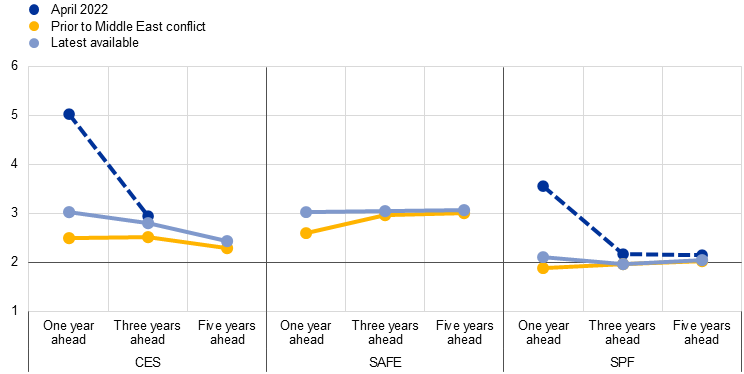
At present, level anchoring of longer-term inflation expectations broadly holds. Across agents, consumers reacted most to the recent energy price shock, but the term structure was strongly downward sloping, as longer-term expectations were revised up only slightly. Longer-term inflation expectations of firms and professional forecasters barely changed following the outbreak of the war in the Middle East (Chart A). While level anchoring is, at face value, weaker for consumers and firms, this can be attributed partly to the systematic upward bias of these two groups.[4] Comparing recent developments to the situation after Russia’s full-scale invasion of Ukraine, the latter inflationary shock was also perceived to be short-lived but started from a higher level of inflation expectations and ultimately persisted longer than originally anticipated (with natural gas prices not peaking until around August-October 2022). In contrast, the current episode has so far generated smaller revisions of longer-term inflation expectations with a stabilisation or moderation of inflation expectations across all agents in the most recent surveys.
Chart A
Term structure of expectations
(annual percentage changes)
Sources: CES, SAFE, SPF and ECB staff calculations.
Notes: For the CES and SAFE, the term structure refers to the median inflation expectation; for the SPF, it refers to the mean inflation expectation. Inflation expectations data from the SAFE were not available in 2022. The latest available data capture expectations from June 2026 for the SAFE and the CES and from the third quarter of 2026 survey round for the SPF.
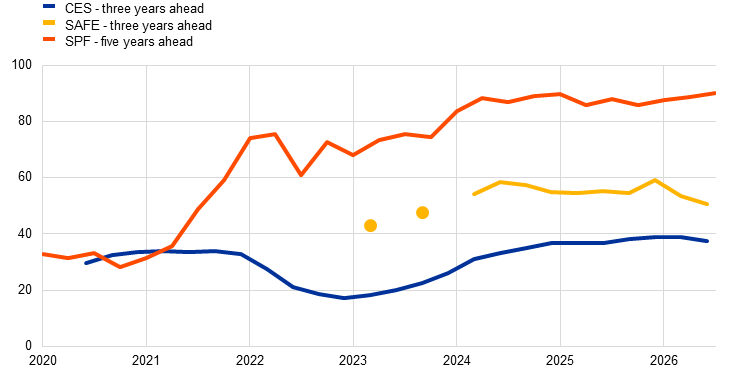
So far, the shares of expectations consistent with the inflation target remain above the levels observed in 2022-2023. Given the differences across agents, it is useful to track the shares of respondents with target-consistent inflation expectations over time (Chart B). In the current episode, these shares, which differ in terms of levels across types of agent, have so far not changed much. They remained relatively high for professionals and ticked down only slightly for consumers, while the share for firms declined more visibly. Nevertheless, for all three groups the shares are above what they were in 2022-2023.
Chart B
Share of target-consistent inflation expectations
(percentages of respondents)
Sources: CES, SAFE, SPF and ECB staff calculations.
Notes: For the CES and SAFE, the target-consistent range for three-year-ahead expected inflation is defined as 1-3%. For the SPF, the target-consistent range for five-year-ahead expected inflation is defined as 1.8-2.2%. The wider range for consumers and firms reflects the greater dispersion and measurement noise typically observed in the expectations of non-professionals.
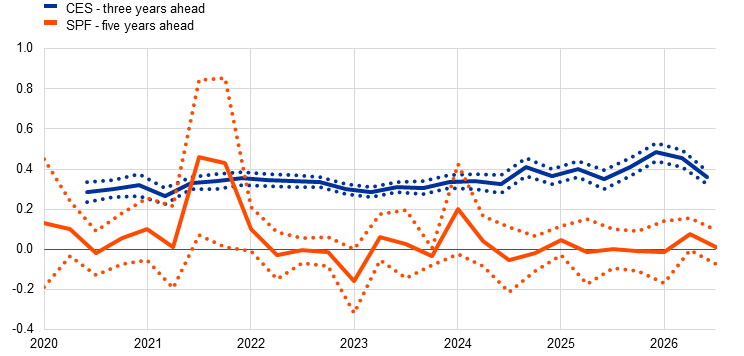
Following the most recent energy price shock, joint dynamics in short and longer-term expectations do not point to increased shock de-anchoring across agents. If a shock is perceived to be temporary, changes in longer-term expectations should not be overly sensitive to changes in short-term ones.[5] For consumers, regression analysis suggests that changes in longer-term expectations are typically positively and significantly sensitive to changes in short-term expectations (Chart C).[6] Recently, this sensitivity has weakened slightly (longer-term expectations have not been revised as strongly as short-term ones). For professional forecasters, changes in longer-term expectations are typically insensitive to changes in short-term ones. While there were exceptions in the last two quarters of 2021 (around the time of the strategy review), those changes were towards the ECB’s price stability target.
Chart C
Relationship between changes in short-term and longer-term inflation expectations
(estimated regression coefficients)
Sources: CES, SPF and ECB staff calculations.
Notes: Ordinary least square estimates with 95% confidence intervals (dotted lines) obtained by regressing quarter-by-quarter (based on pooled three-monthly waves with fixed individual and time effects for the CES) individual-level revisions in three-year-ahead (five-year-ahead for the SPF) expectations between two consecutive surveys on revisions in one-year-ahead expectations.
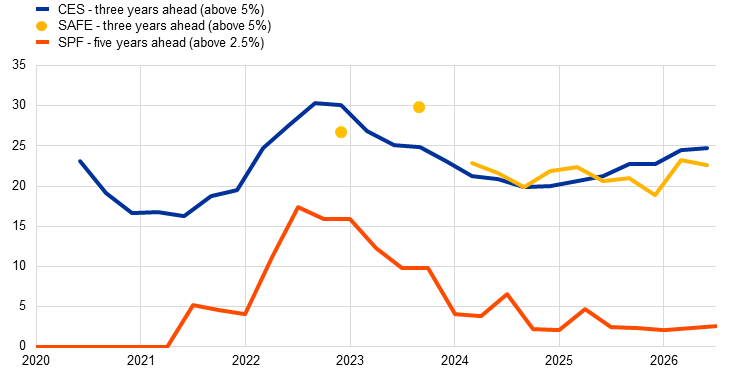
Stable levels of disagreement and a contained share of agents expecting high inflation suggest higher-moment anchoring, although the signal is weaker for non-professionals. Higher-moment anchoring relates to dispersion, skew and outliers. Regarding dispersion, disagreement among agents, as measured by the interquartile range of the cross-sectional distribution of longer-term expectations, has not changed substantially. It has remained below its long-term average among professional forecasters and has also been broadly stable for consumers and firms.[7] Overall, disagreement has declined from the highs of 2022-2023 (Chart D, panel a). Disagreement is also substantially higher among consumers and firms than among professional forecasters. Beyond disagreement, uncertainty surrounding reported expectations (using a variety of metrics) appears to have increased initially after the war, but this has started to recede in the latest data for consumers and firms. Regarding skew and outliers, the share of respondents with high expectations (expected inflation above 5% for firms and consumers and above 2.5% for professional forecasters) increased very slightly for professional forecasters but more visibly among consumers and firms, although for firms it has decreased in the latest wave (Chart D, panel b). However, these shares stand below the elevated levels of 2022-2023.
Chart D
Disagreement among agents and share expecting high inflation
a) Interquartile range of agents’ inflation expectations
(percentage points)

b) Share of agents expecting high inflation
(percentages of respondents)
Sources: CES, SAFE, SPF and ECB staff calculations.
Notes: Panel a): Interquartile ranges are constructed from the difference between the third and first quartiles of the point forecasts. Panel b): High inflation shares are calculated as the percentages of respondents with three-year-ahead expectations above 5% for the CES and SAFE, and as the percentage of respondents with five-year-ahead expectations above 2.5% for the SPF. In the third quarter of 2026, only one SPF respondent reported expectations above 2.5% (at 3.5%). The latest observations are for June 2026 for the CES, the second quarter of 2026 for the SAFE and the third quarter of 2026 for the SPF.
Although the degree of anchoring of longer-term expectations remains close to the levels prevailing before the Middle East energy shock, close monitoring of inflation expectations is warranted. Shorter-term inflation expectations moved upwards initially after the outbreak of the war in the Middle East, as have some longer-term measures, albeit to a much more limited extent. Since the initial shock, incoming information indicates that survey inflation expectations have stabilised or corrected downwards to some extent. Monitoring a wide range of metrics is warranted as some economic agents may be displaying heightened sensitivity to recent inflation developments owing to their recall of the 2022-2023 inflation surge.
References
Fantino, D., Ferrando, A., Groß, J., Lamboglia, S., Lebastard, L., Rariga, J. and Schmidt, M. (2026), “How the war in the Middle East is reshaping euro area firms’ expectations”, The ECB Blog, ECB, 26 May.
Neri, S., Bulligan, G., Cecchetti, S., Corsello, F., Papetti, A., Riggi, M., Rondinelli, C. and Tagliabracci, A. (2022), “On the anchoring of inflation expectations in the euro area”, Questioni di Economia e Finanza (Occasional Papers), No 712, Banca d’Italia, September.
Reis, R. (2021), “Losing the Inflation Anchor”, Brookings Papers on Economic Activity, September.
Reis, R. (2026), “Why did Inflation Rise and Fall in 2021-24? Channels and Evidence from Expectations”, CEPR Discussion Paper, No 21277, March.
Weber, M., D’Acunto, F., Gorodnichenko, Y. and Coibion, O. (2022), “The Subjective Inflation Expectations of Households and Firms: Measurement, Determinants, and Implications”, Journal of Economic Perspectives, Vol. 36, No 3, pp. 157-184.
Work stream on inflation expectations (2021), “Inflation expectations and their role in Eurosystem forecasting”, Occasional Paper Series, No 264, ECB, September.
Workstream 1: Changing economic and inflation environment (2025), “A strategic view on the economic and inflation environment in the euro area”, Occasional Paper Series, No 371, ECB, June.
Legal Disclaimer:
EIN Presswire provides this news content "as is" without warranty of any kind. We do not accept any responsibility or liability for the accuracy, content, images, videos, licenses, completeness, legality, or reliability of the information contained in this article. If you have any complaints or copyright issues related to this article, kindly contact the author above.
