

Premium Apparel Market to Reach USD 793.31 Billion by 2035, Growing at 7.5% CAGR
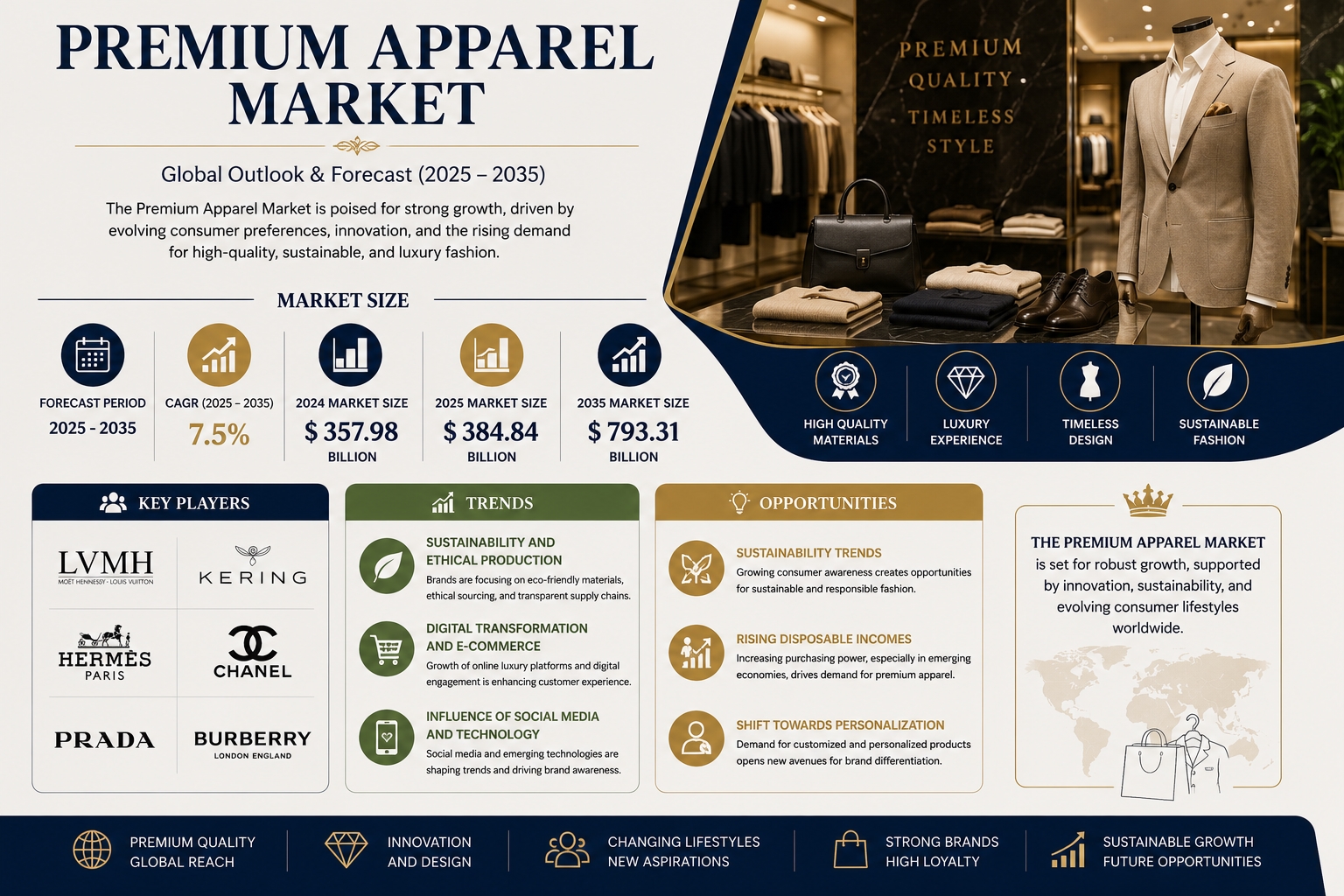
Premium apparel Market
Rising demand for luxury craftsmanship, sustainable production, and personalized digital shopping experiences is reshaping the global premium apparel industry
Sustainability, digital transformation, and the growing consumer appetite for personalized, high-quality fashion are redefining what premium apparel means for the next decade”
NEW YORK, NY, UNITED STATES, July 22, 2026 /EINPresswire.com/ -- The global Premium Apparel Market is on a robust growth trajectory, with its valuation projected to expand from USD 384.84 billion in 2025 to USD 793.31 billion by 2035, registering a compound annual growth rate (CAGR) of 7.5% over the forecast period 2025 to 2035. The market was valued at USD 357.98 billion in 2024, underscoring a steady acceleration in global demand for high-quality, status-driven apparel, footwear, and accessories. This near-doubling of market value over the coming decade reflects a fundamental shift in consumer spending patterns toward craftsmanship, exclusivity, and brands that align with personal identity and values, spanning clothing, footwear, and accessories categories worldwide.— Market Research Future (MRFR)
Premium apparel, encompassing high-end clothing, footwear, and accessories produced by heritage fashion houses, luxury conglomerates, and premium contemporary labels, has moved beyond a narrow circle of ultra-affluent consumers to capture a broadening base of aspirational shoppers. Once defined primarily by exclusivity and price point, the category is increasingly being redefined by consumers who expect premium goods to also demonstrate ethical production, environmental responsibility, and digital-first engagement, driven by mounting demand for transparency and a global consumer base increasingly investing in quality over quantity.
Market Overview: A Decade of Sustained Expansion
The premium apparel industry sits at the intersection of fashion craftsmanship, brand heritage, and evolving retail technology. As disposable incomes rise across both mature and emerging economies, and as consumers increasingly view personal style as an extension of identity and status, demand for apparel that delivers verifiable quality, exclusivity, and provenance has surged. The market's projected CAGR of 7.5% through 2035 signals sustained, structural demand growth rather than a short-term post-pandemic rebound, suggesting that premium apparel has become embedded in long-term consumer spending patterns across both developed and emerging markets.
This growth is further underpinned by continuous innovation in digital retail, sustainable material sourcing, and supply chain transparency that allow brands to justify premium price points while broadening their addressable consumer base. As a result, premium apparel brands that were once confined to flagship boutiques and department store counters are now reaching consumers through direct-to-consumer e-commerce, social commerce, and immersive digital experiences, expanding the category's reach well beyond its traditional luxury retail footprint.
Get Full PDF Sample Copy of Report: (Including Full TOC, List of Tables and Figures, Chart) @ https://www.marketresearchfuture.com/sample_request/16088
Market Segmentation: Clothing Dominates, Footwear Accelerates
The Premium Apparel Market report from Market Research Future segments the industry primarily by Category and Region, each offering a distinct lens into where growth is concentrated.
By Category, the market spans Clothing, Footwear, and Accessories. Clothing remains the dominant segment, accounting for the largest share of consumer spending and valued in a range of approximately USD 150 billion to USD 350 billion across the forecast period, owing to its broad appeal, extensive product variety, and role as the primary touchpoint through which premium brands build loyalty. High-quality fabrics, tailored fits, and luxurious aesthetics continue to define the category, with brands continuously innovating to meet the evolving tastes of fashion-forward consumers. Footwear, valued in a range of roughly USD 100 billion to USD 200 billion over the same period, is emerging as the fastest-growing category, propelled by sneaker culture, athleisure adoption, and footwear brands' incorporation of cutting-edge comfort technology and sustainable materials. Accessories, valued between approximately USD 108 billion and USD 243 billion, round out the category mix, holding a smaller but steadily expanding share as consumers embrace a more holistic approach to premium dressing and personal expression.
By Geography, the market spans North America, Europe, Asia-Pacific, and the Rest of the World. North America remains the largest regional market, while Asia-Pacific is emerging as the fastest-growing region for premium apparel, driven by an expanding middle class and rising luxury consumption among younger demographics.
Key Trends Shaping the Market Through 2035
The Market Research Future report identifies several defining trends that will shape the trajectory of the premium apparel industry over the next decade.
Sustainability and Ethical Production
Sustainability and ethical production practices are becoming central to consumer preferences in the premium apparel market, as increasingly discerning shoppers seek high-quality products that reflect their personal values as much as their personal style. Brands are responding by enhancing transparency in their supply chains and adopting eco-friendly practices, including greater use of organic and traceable materials, reduced production waste, and public commitments to measurable environmental targets.
Digital Transformation and E-commerce
The rise of digital platforms is revolutionizing the premium apparel market, offering personalized shopping experiences that allow consumers to engage directly with brands. This shift is fostering deeper brand loyalty and enhancing visibility, as premium labels invest in direct-to-consumer channels, mobile commerce, and data-driven personalization to meet consumers wherever they choose to shop.
Influence of Social Media and Technology
Social media platforms and celebrity endorsements are significantly shaping consumer preferences and brand visibility within the premium apparel market. These channels enable brands to reach wider audiences and cultivate loyal, engaged communities, while technological innovations such as augmented reality and virtual fitting rooms are making the shopping experience increasingly interactive and immersive, helping bridge the gap between digital discovery and considered purchase.
Rise of Personalization and Bespoke Offerings
The shift toward personalization is emerging as a critical driver of consumer engagement, as shoppers increasingly seek unique, tailored experiences rather than mass-produced goods. Brands that offer customizable options, made-to-order services, or limited-edition collections are positioned to capture greater consumer loyalty, supported by advancements in data analytics that allow brands to better understand and anticipate individual preferences.
Growing Influence of Celebrity and Influencer Partnerships
High-profile collaborations between celebrities, influencers, and premium apparel brands continue to shape trends and drive visibility, particularly within the luxury segment, where exclusivity and brand prestige remain paramount. As social platforms continue to amplify these partnerships, brands that strategically leverage celebrity and influencer relationships are likely to see enhanced engagement and sales momentum.
Technological Advancements in Retail
The integration of e-commerce, mobile shopping, and immersive technologies is reshaping how consumers interact with premium apparel brands. A growing share of premium apparel sales now occurs online, prompting brands to enhance their digital presence and invest in tools such as augmented reality and virtual try-on features that allow consumers to visualize products before purchase.
Competitive Landscape: Heritage Houses and Global Icons Driving Innovation
The Premium Apparel Market remains characterized by the presence of several well-established global players with deep expertise in craftsmanship, brand heritage, and international retail infrastructure. Key companies profiled in the report include LVMH, Kering, Hermes, Chanel, Prada, Burberry, Ralph Lauren, Giorgio Armani, Dolce and Gabbana, and Versace, alongside major contemporary premium brands such as Levi's, Victoria's Secret, Tommy Hilfiger, Michael Kors, Lululemon, Calvin Klein, Coach, Hugo Boss, and Lacoste.
These industry leaders are pursuing a range of strategic initiatives to strengthen their market positions, including sustained investment in research and development, new product launches, strategic partnerships, mergers and acquisitions, and expanded manufacturing footprints designed to help brands offer reasonably priced goods while remaining competitive in an increasingly dynamic market. Manufacturing locally has emerged as a key strategy among premium apparel producers seeking to reduce operational costs while supporting broader market expansion.
Several leading players have placed sustainability at the center of their corporate strategies. Levi Strauss and Co., founded in 1853 and headquartered in San Francisco, California, announced in 2020 that it had achieved carbon neutrality across its entire business, and in May 2021 launched a program with the International Finance Corporation to support sustainable cotton farming practices in India. Ralph Lauren, founded in 1967 and headquartered in New York City, declared in August 2020 that its full supply chain and operations had reached net-zero greenhouse gas emissions, and in June 2021 announced a partnership with the Ellen MacArthur Foundation to accelerate the shift toward a circular fashion economy. Other notable industry developments include Tommy Hilfiger's March 2021 partnership with the Ellen MacArthur Foundation and its February 2020 announcement that all cotton used in its products was sustainably sourced, as well as Michael Kors' January 2021 partnership with the United Nations World Food Programme in support of global hunger relief efforts.
Regional Dynamics
North America — Luxury Market Leader (~40% share)
North America continues to represent the largest regional market for premium apparel, holding approximately 40% of global market share. Growth in the region is underpinned by rising disposable incomes, strong consumer preference for luxury brands, and increasing online shopping adoption, supported by a regulatory environment favorable to e-commerce and retail innovation. The United States leads the region, with meaningful contributions from Canada, and major players including Ralph Lauren and Burberry maintain a strong presence alongside a competitive mix of established luxury houses and emerging designers.
Europe — Cultural Fashion Hub (~30% share)
Europe represents the second-largest regional market, accounting for approximately 30% of global share. The region benefits from a rich cultural heritage in fashion, with strong demand from both local and international consumers, supported by regulatory frameworks that promote sustainable practices and luxury branding. France, Italy, and the United Kingdom lead the region, home to iconic houses such as LVMH, Chanel, and Gucci, in a competitive landscape blending heritage brands with innovative newcomers.
Asia-Pacific — Emerging Luxury Market (~25% share)
Asia-Pacific is witnessing rapid growth, currently holding approximately 25% of global market share, and is expected to be a primary growth engine over the forecast period. Key drivers include a burgeoning middle class, accelerating urbanization, and growing appetite for luxury goods among younger consumers, supported by regulatory initiatives aimed at enhancing trade and e-commerce. China and Japan lead the region, with significant contributions from South Korea and India, while brands including Prada and Versace continue expanding their footprints to capture evolving consumer tastes.
Middle East and Africa — Emerging Luxury Frontier (~5% share)
The Middle East and Africa represent an emerging frontier, accounting for approximately 5% of global market share, with growth driven by rising disposable incomes, a young population, and increasing interest in luxury fashion. The UAE and South Africa lead regional demand, supported by a growing number of luxury retail outlets and fashion events, with key players including Dolce and Gabbana and Giorgio Armani signaling the region's long-term potential.
Market Drivers and Opportunities
Several structural factors underpin the sustained growth outlook for the premium apparel industry. Sustainability has become a pivotal driver, as consumers increasingly seek eco-friendly and ethically produced clothing and demonstrate a willingness to pay a premium for products that reflect environmental responsibility, prompting brands to adopt organic materials and waste-reduction practices at scale.
Rising disposable incomes represent a second major driver, particularly across emerging markets where economic growth has fueled a burgeoning middle class increasingly willing to invest in high-quality apparel that reflects personal style and status. This shift indicates a growing appreciation for craftsmanship and exclusivity, hallmarks of the premium apparel segment, with brands that position themselves effectively within this trend well placed to benefit from rising consumer spending.
The shift toward personalization presents a further significant opportunity, as brands that offer bespoke services, customizable options, or limited-edition collections are positioned to capture greater market share by enhancing customer satisfaction and long-term loyalty. Looking ahead, emerging opportunities include expansion into sustainable materials sourcing, the development of AI-powered personalized shopping experiences, and strategic partnerships with luxury influencers to strengthen brand visibility across digital channels.
Market Restraints and Challenges
Despite the positive growth outlook, the industry faces several notable challenges. Balancing brand exclusivity with the scale demanded by digital and e-commerce expansion remains an ongoing tension for premium and luxury houses, as broader accessibility can, if not carefully managed, dilute the sense of scarcity that underpins premium pricing. The proliferation of counterfeit goods and unauthorized resale channels continues to pose reputational and revenue risks across the category, particularly as digital marketplaces make counterfeit products more accessible to consumers.
Rising costs associated with sustainable sourcing, ethical labor practices, and supply chain transparency also present near-term margin pressure, even as they represent important long-term brand differentiators. Additionally, as consumer awareness of sustainability claims grows, so too does scrutiny of brand messaging, placing pressure on premium apparel companies to substantiate environmental and ethical claims credibly in order to avoid reputational risk associated with perceived greenwashing. Broader macroeconomic headwinds, including inflationary pressure on discretionary consumer spending, may also periodically temper demand growth in certain markets, even as the category's long-term structural drivers remain intact.
Outlook
With the market projected to grow from USD 384.84 billion in 2025 to USD 793.31 billion by 2035, the premium apparel industry is positioned for a decade of sustained, quality-driven growth. Companies that successfully combine heritage craftsmanship, credible sustainability commitments, and consumer-centric digital innovation, particularly around personalization and immersive retail experiences, are likely to capture a disproportionate share of this expanding market. As global consumers continue to prioritize quality, exclusivity, and values-aligned brands over mass-market alternatives, premium apparel is set to play an increasingly central role in the future of global fashion and retail.
Discover Related Research Reports By Market Research Future
Online Apparel Market
https://www.marketresearchfuture.com/reports/online-apparel-market-16085
Hunting Apparel Market
https://www.marketresearchfuture.com/reports/hunting-apparel-market-33751
Motorcycle Apparel Market
https://www.marketresearchfuture.com/reports/motorcycle-apparel-market-7990
Sagar Kadam
Market Research Future
+ +1 628-258-0071
email us here
Legal Disclaimer:
EIN Presswire provides this news content "as is" without warranty of any kind. We do not accept any responsibility or liability for the accuracy, content, images, videos, licenses, completeness, legality, or reliability of the information contained in this article. If you have any complaints or copyright issues related to this article, kindly contact the author above.
