

E-Coat Market to Near $5.76 Billion by 2035 as EV Dielectric Requirements and VOC Mandates Reshape Automotive Finishing
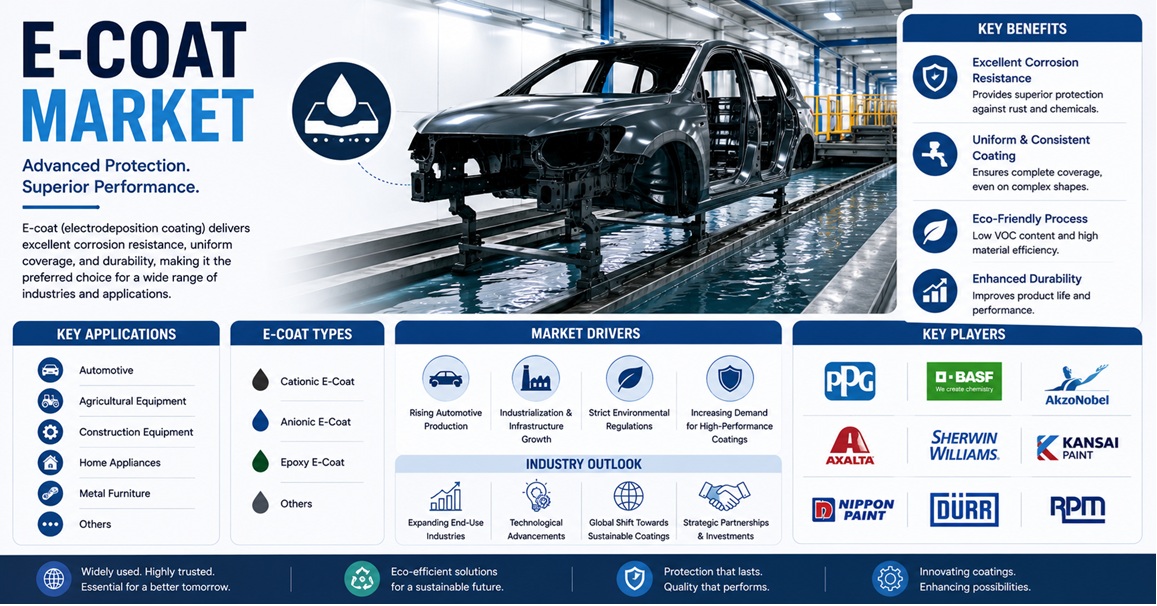
E-Coat Market (2026 - 2035)
North America holds approximately 22.0% of global demand, supported by U.S. defense and agricultural-equipment procurement.
WA, UNITED STATES, July 22, 2026 /EINPresswire.com/ -- According to a comprehensive report by Market Research Future (MRFR), the global E-Coat market reached an estimated USD 3.50 billion in 2025 and is projected to grow from USD 3.68 billion in 2026 to USD 5.76 billion by 2035, advancing at a compound annual growth rate of 5.10%. This expansion is being driven by three converging forces: the shift to 800-volt electric vehicle architectures that demand dielectric coatings traditional spray primers cannot match, tightening VOC emission regulations that are retiring solvent-based processes across North America and Europe, and the relentless expansion of vehicle production in Asia-Pacific where new assembly plants specify e-coat as the default corrosion-protection standard.The EV Dielectric Imperative: Voltage as Market Architect
The single most transformative demand driver for the E-Coat market is the electrification of vehicle architectures. The shift to 800-volt EV platforms—now standard on vehicles from Hyundai, Porsche, and multiple Chinese OEMs—demands coatings with dielectric strength exceeding 1,000 V/mil. Cathodic epoxy electrodeposition delivers this specification at roughly 30% lower cost per unit area than powder-on-primer alternatives. BloombergNEF estimates that global EV battery-housing production will exceed 28 million units annually by 2030, each requiring a full-body e-coat cycle. This single application segment could add USD 0.35 billion in incremental demand to the E-Coat market by 2032.
The EV transition is not merely additive; it is fundamentally reshaping coating specifications. Traditional internal combustion vehicles required corrosion protection on steel body panels and underbody components. EVs add aluminum castings, battery enclosures, motor housings, and structural components that each demand compatible primer chemistries. The mix of substrates—galvanized steel, aluminum extrusions, and die-cast magnesium—requires e-coat formulations that prevent galvanic corrosion while maintaining adhesion across dissimilar metals. This complexity drives reformulation investment among resin suppliers and creates a premium tier within the E-Coat market that commodity coating providers cannot easily replicate.
Download Report Sample Copy: https://www.marketresearchfuture.com/sample_request/1911
The Regulatory Squeeze: VOC Mandates as Demand Catalyst
The second major force propelling the E-Coat market is environmental regulation. The U.S. EPA's 2024 update to National Emission Standards for Hazardous Air Pollutants (NESHAP Subpart MMMM) lowered permissible VOC limits for surface-coating operations by 15%, effective January 2026. In Europe, the revised Industrial Emissions Directive sets a 2028 deadline for Best Available Techniques compliance, which effectively mandates closed-loop electrodeposition for any facility coating more than 5,000 tonnes of metal annually. Paint shops that once relied on conventional spray primers are retrofitting to e-coat lines to avoid non-compliance penalties that can reach EUR 50,000 per violation event.
E-coat's inherent advantage is its transfer efficiency. Cathodic electrodeposition lines achieve 95%+ transfer efficiency, meaning nearly all resin material adheres to the substrate rather than escaping as overspray. Legacy spray processes typically waste 40–60% of coating material to the atmosphere. This efficiency advantage is not merely environmental; it is economic. At USD 0.08–0.12 per square foot applied, e-coat undercuts powder primer costs of USD 0.14–0.20 per square foot because reduced waste more than compensates for higher bath-maintenance complexity.
Between 2023 and 2025, automakers and Tier-1 suppliers committed over USD 1.2 billion to new e-coat installation capacity across China, India, and Mexico. These investments reflect the dual pressure of decarbonization mandates and rising consumer demand for longer corrosion warranties on passenger vehicles. The regulatory trajectory is clear: solvent-based spray primers are being regulated out of existence, and e-coat is the default replacement technology.
Product and Chemistry Dynamics
Cathodic systems accounted for 92.5% of E-Coat market volume in 2025, reinforcing their dominance in high-corrosion-risk substrates. Cathodic electrodeposition—where the vehicle body acts as the cathode and resin particles carry positive charge—produces uniform films in recessed areas, a critical requirement for complex automotive body geometries. The throwing power of cathodic systems ensures that inner panel surfaces, seam flanges, and box sections receive adequate coating thickness even where spray nozzles cannot reach.
Anodic systems are growing at a 3.85% CAGR through 2035, finding niche traction in decorative aluminum finishing and small-parts applications where milder deposition conditions reduce substrate etching risk. While limited to a small share, anodic systems retain relevance in architectural aluminum and specialty applications where cathodic chemistry would compromise surface finish.
By technology, epoxy formulations captured 84.5% of total volume in 2025, favored for their superior salt-spray resistance and bath stability. Epoxy e-coats routinely exceed 1,000-hour salt-spray test requirements demanded by automakers, providing the foundational corrosion protection upon which basecoat and clearcoat layers build. Acrylic formulations are expanding at a 5.55% CAGR, the fastest technology growth rate, as exterior UV-durability requirements rise. Where epoxy's tendency to chalk under prolonged sun exposure limits its use on visible surfaces, acrylic formulations provide the weathering resistance necessary for topcoat-compatible primer applications.
Hybrid epoxy-acrylic chemistries, still in early commercialization, may bridge both performance profiles by 2030—offering the corrosion resistance of epoxy with the UV stability of acrylic in a single bath formulation.
Application Landscape: Passenger Cars Anchor, Heavy Equipment Surges
Passenger cars represented the largest application within the E-Coat market in 2025, growing at a 5.45% CAGR through 2035. The transition to dedicated EV platforms—with their unique mix of aluminum castings, steel stampings, and battery enclosures—is adding complexity to e-coat recipes and driving reformulation investment. Each new EV assembly line requires a complete e-coat system, from pre-treatment through ultrafiltration to curing ovens, creating a capital-equipment and chemical-consumption double dividend for the market.
Commercial vehicles generated USD 0.52 billion in 2025, with fleet electrification expanding the addressable base beyond traditional diesel truck and bus production. Heavy-duty equipment is projected to reach USD 0.49 billion by 2035, propelled by global infrastructure spending that the World Bank estimates at USD 3.7 trillion annually through 2030. Construction and mining equipment operating in C5-X corrosion environments demand primer performance that only e-coat can deliver cost-effectively.
Automotive parts and accessories held 10.5% of the market in 2025, serving aftermarket and Tier-1 supply chains where smaller batch sizes favor flexible e-coat toll-coating operations. Appliances captured 6.5% of the market, with premium warranty requirements—10+ year corrosion guarantees—driving specification in washing machines, refrigerators, and HVAC equipment. Emerging-market appliance premiumization in India, Brazil, and Southeast Asia is expanding this segment at over 6% annually.
Purchase Now: https://www.marketresearchfuture.com/checkout?currency=one_user-USD&report_id=1911
Regional Dynamics: Asia-Pacific Dominates, All Regions Transform
Asia-Pacific commands roughly 51.5% of the E-Coat market, the largest regional share, and simultaneously posts the fastest CAGR at 5.45% through 2035. The region's dominance is structural: China produced 30.2 million vehicles in 2024, while India crossed 6.0 million units for the first time. Both countries have announced production-linked incentive schemes that subsidize coating-line installation at greenfield assembly plants. India's PLI scheme for the auto sector allocates INR 25,938 crore through 2028, and at least 40% of approved applicants have specified cathodic e-coat lines in their capital-expenditure plans.
China alone accounts for 58.0% of regional share, with its position as the world's largest vehicle producer creating an insatiable demand for e-coat capacity. Japan contributes USD 0.31 billion through technology leadership and robotics integration in coating-line automation. South Korea's 4.95% CAGR reflects EV-platform expansion by Hyundai-Kia and battery-supplier coating requirements. The ASEAN bloc is advancing at a 5.60% CAGR on motorcycle and two-wheeler coating demand.
North America holds the second-largest share at approximately 22.0%, driven by reshoring trends in agricultural-equipment manufacturing and defense procurement. The United States accounts for 74.0% of regional share, where EPA NESHAP compliance and the Department of Defense's USD 1.1 billion Corrosion Prevention and Control program are sustaining demand. Cathodic e-coat systems are qualifying as MIL-DTL-53072 replacements on Stryker and JLTV platforms, opening a defense-adjacent demand channel. Canada's auto-parts manufacturing corridor and Mexico's nearshoring of vehicle assembly—BMW, Audi, and KIA expanding capacity in Nuevo León and Guanajuato—add incremental volume.
Europe follows at 18.5%, where the Green Deal's sustainability benchmarks continue to push appliance and automotive OEMs toward lower-emission finishing technologies. Germany anchors regional demand at a 5.40% CAGR through premium automotive OEMs—Volkswagen, BMW, and Mercedes-Benz—operating some of the world's most advanced e-coat lines. The EU's Carbon Border Adjustment Mechanism indirectly supports domestic coating operations by increasing the landed cost of imported pre-coated components. The UK's 4.65% CAGR reflects commercial-vehicle electrification, while France's appliance-sector mandates and Italy's agricultural machinery production sustain demand across the continent.
South America holds 4.5% of global share, with Brazil dominating at 68.0% through FINAME agricultural-equipment financing and local-content requirements for corrosion-grade coating. The region represents the largest capacity-gap opportunity in the E-Coat market, with fewer than 15 dedicated e-coat facilities operating across the entire continent.
The Middle East & Africa, at 3.5%, is the smallest but fastest-emerging region. Saudi Arabia's Vision 2030 includes establishing domestic vehicle-assembly capacity through the Lucid Motors partnership, and the NEOM industrial zone has specified advanced coating lines in its manufacturing-campus design.
Report Summary: https://www.marketresearchfuture.com/reports/e-coat-market-1911
Competitive Landscape
The E-Coat market exhibits medium concentration, with the top five companies collectively holding an estimated 55–62% revenue share and a Herfindahl-Hirschman Index in the 1,200–1,500 range. Barriers to entry center on resin-formulation IP, global technical-service networks, and long-term OEM qualification cycles that can span 18–36 months.
PPG Industries leads with an estimated 14–18% revenue share, distinguished by its CathoGuard and Powercron cathodic systems and global automotive OEM relationships. In May 2025, PPG introduced pretreatment and e-coat platforms for corrosion protection and dielectric isolation—including the PPG CORATHERM TCA-4000—at The Battery Show Europe, directly targeting EV battery-housing applications.
BASF SE captures 10–14% through integrated chemicals and coatings capabilities, including CathoGuard partnership formulations and custom resin supply. Axalta Coating Systems holds 9–13% with its AquaEC cathodic e-coat line, serving automotive refinish and OEM markets. In January 2025, Axalta launched AquaEC 3500, a low-bake cathodic e-coat formulated for mixed-metal EV body assemblies requiring cure temperatures below 165°C—a formulation that reduces energy costs while accommodating heat-sensitive aluminum substrates.
Nippon Paint Holdings accounts for 8–11% with its Power Top and Power Float series, anchoring Asia-Pacific market leadership. KCC Corporation holds 5–8% through South Korea and ASEAN presence with KCC E-Coat cathodic and anodic systems. Henkel AG & Co. KGaA captures 4–7% by bundling pre-treatment and e-coat integration under its Aquence brand. Sherwin-Williams Company holds 3–6% with its Valspar cathodic e-coat line in North American industrial coatings. Kansai Paint Co., Ltd. accounts for 3–5% with its Electrocoat series for appliances, while Nordson Corporation leverages application equipment and controls expertise at 2–4%.
Related Report
automotive oem interior coating market https://www.marketresearchfuture.com/reports/automotive-oem-interior-coating-market-35437
Automotive Metal Die Casting Market https://www.marketresearchfuture.com/reports/automotive-metal-die-casting-market-7698
Automotive Wheel Coating Market https://www.marketresearchfuture.com/reports/automotive-wheel-coating-market-3144
Automotive paint Market https://www.marketresearchfuture.com/reports/automotive-paint-market-22079
automotive engine oil market https://www.marketresearchfuture.com/reports/automotive-engine-oil-market-35436
Market Research Future
Market Research Future
+1 855-661-4441
email us here
Legal Disclaimer:
EIN Presswire provides this news content "as is" without warranty of any kind. We do not accept any responsibility or liability for the accuracy, content, images, videos, licenses, completeness, legality, or reliability of the information contained in this article. If you have any complaints or copyright issues related to this article, kindly contact the author above.
