

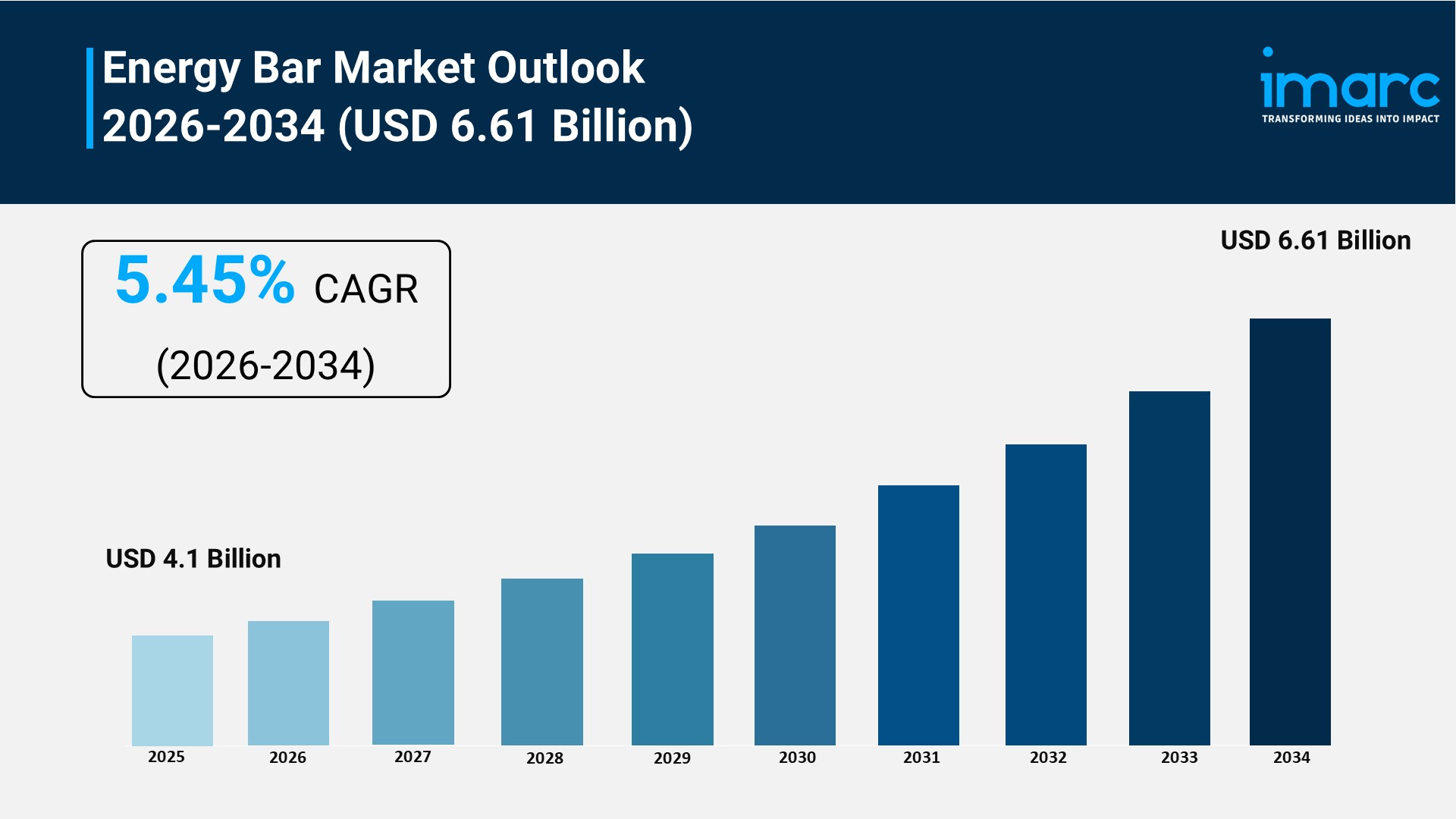
Energy Bar Market to Reach USD 6.61 Billion by 2034, Growing at a CAGR of 5.45%
𝐑𝐞𝐩𝐨𝐫𝐭 𝐇𝐢𝐠𝐡𝐥𝐢𝐠𝐡𝐭𝐬
● 𝐌𝐚𝐫𝐤𝐞𝐭 𝐒𝐢𝐳𝐞 (𝟐𝟎𝟐𝟓): 𝐔𝐒𝐃 𝟒.𝟏 𝐁𝐢𝐥𝐥𝐢𝐨𝐧
● 𝐅𝐨𝐫𝐞𝐜𝐚𝐬𝐭 (𝟐𝟎𝟑𝟒): 𝐔𝐒𝐃 𝟔.𝟔𝟏 𝐁𝐢𝐥𝐥𝐢𝐨𝐧
● 𝐂𝐀𝐆𝐑 (𝟐𝟎𝟐𝟔–𝟐𝟎𝟑𝟒): 𝟓.𝟒𝟓%
● 𝐋𝐞𝐚𝐝𝐢𝐧𝐠 𝐑𝐞𝐠𝐢𝐨𝐧: 𝐍𝐨𝐫𝐭𝐡 𝐀𝐦𝐞𝐫𝐢𝐜𝐚 (𝟑𝟓%)
● 𝐓𝐨𝐩 𝐓𝐲𝐩𝐞: 𝐏𝐫𝐨𝐭𝐞𝐢𝐧 𝐁𝐚𝐫 (𝟒𝟎%)
● 𝐅𝐚𝐬𝐭𝐞𝐬𝐭-𝐆𝐫𝐨𝐰𝐢𝐧𝐠 𝐒𝐞𝐠𝐦𝐞𝐧𝐭: 𝐂𝐚𝐧𝐜𝐞𝐫/𝐅𝐮𝐧𝐜𝐭𝐢𝐨𝐧𝐚𝐥 & 𝐏𝐥𝐚𝐧𝐭-𝐁𝐚𝐬𝐞𝐝 𝐕𝐚𝐫𝐢𝐚𝐧𝐭𝐬
● 𝐍𝐚𝐭𝐮𝐫𝐞: 𝐂𝐨𝐧𝐯𝐞𝐧𝐭𝐢𝐨𝐧𝐚𝐥 𝐥𝐞𝐚𝐝𝐬 𝐰𝐢𝐭𝐡 𝟔𝟓% 𝐬𝐡𝐚𝐫𝐞
𝐃𝐨𝐰𝐧𝐥𝐨𝐚𝐝 𝐚 𝐅𝐫𝐞𝐞 𝐒𝐚𝐦𝐩𝐥𝐞 𝐂𝐨𝐩𝐲 𝐨𝐟 𝐭𝐡𝐞 𝐑𝐞𝐩𝐨𝐫𝐭: https://www.imarcgroup.com/energy-bar-market/requestsample
𝐄𝐧𝐞𝐫𝐠𝐲 𝐁𝐚𝐫 𝐌𝐚𝐫𝐤𝐞𝐭 𝐎𝐮𝐭𝐥𝐨𝐨𝐤 𝟐𝟎𝟐𝟔–𝟐𝟎𝟑𝟒
Energy bars are portable, nutrient-dense snack products designed to deliver sustained energy, protein supplementation, and functional nutrition benefits to consumers across fitness, athletic, and on-the-go lifestyle segments. Originally developed for athletes and endurance sports participants, energy bars have evolved into a mainstream snacking category now expanding aggressively into plant-based nutrition, functional wellness, personalized dietary solutions, and clean-label product formats.
The market reached USD 4.1 Billion in 2025 and is projected to reach USD 6.61 Billion by 2034 at a 5.45% CAGR, driven by rising health consciousness among consumers globally, growing adoption of fitness-oriented lifestyles, increasing demand for convenient on-the-go nutrition solutions, and expanding product diversification with plant-based and functionally enriched variants.
𝐄𝐧𝐞𝐫𝐠𝐲 𝐁𝐚𝐫 𝐌𝐚𝐫𝐤𝐞𝐭 𝐃𝐫𝐢𝐯𝐞𝐫𝐬 𝟐𝟎𝟐𝟔
𝟏. 𝐑𝐢𝐬𝐢𝐧𝐠 𝐇𝐞𝐚𝐥𝐭𝐡 𝐀𝐰𝐚𝐫𝐞𝐧𝐞𝐬𝐬 𝐚𝐧𝐝 𝐅𝐢𝐭𝐧𝐞𝐬𝐬 𝐂𝐮𝐥𝐭𝐮𝐫𝐞
The increasing health awareness among consumers globally is one of the primary growth drivers for the energy bar market. Consumers are increasingly conscious about healthy eating, portable nutrition, and meal supplementation, fueling demand for energy bars as convenient alternatives that provide sustained energy without compromising nutritional content. The growing trend of gym participation, outdoor activities, and fitness regimes is further reinforcing demand across diverse demographics.
𝟐. 𝐄𝐱𝐩𝐚𝐧𝐝𝐢𝐧𝐠 𝐏𝐥𝐚𝐧𝐭-𝐁𝐚𝐬𝐞𝐝 𝐚𝐧𝐝 𝐅𝐮𝐧𝐜𝐭𝐢𝐨𝐧𝐚𝐥 𝐏𝐫𝐨𝐝𝐮𝐜𝐭 𝐏𝐢𝐩𝐞𝐥𝐢𝐧𝐞𝐬
The shift toward plant-based nutrition is significantly influencing product development in the energy bar industry. Consumers are increasingly seeking bars formulated with plant-derived proteins such as pea, hemp, brown rice, and soy. Simultaneously, manufacturers are enriching bars with added vitamins, minerals, probiotics, adaptogens, and superfoods to deliver targeted health benefits beyond basic nutrition, unlocking a new class of functional snacking solutions advancing rapidly through retail and e-commerce channels.
𝟑. 𝐆𝐫𝐨𝐰𝐢𝐧𝐠 𝐃𝐞𝐦𝐚𝐧𝐝 𝐟𝐨𝐫 𝐂𝐥𝐞𝐚𝐧-𝐋𝐚𝐛𝐞𝐥 𝐚𝐧𝐝 𝐓𝐫𝐚𝐧𝐬𝐩𝐚𝐫𝐞𝐧𝐭 𝐅𝐨𝐫𝐦𝐮𝐥𝐚𝐭𝐢𝐨𝐧𝐬
Consumer demand for transparency in food labeling is profoundly influencing product formulation strategies within the energy bar sector. Shoppers are increasingly favoring bars made with whole, recognizable ingredients that are free from artificial preservatives, colors, sweeteners, and genetically modified organisms. Certifications such as organic, non-GMO, and fair trade are becoming critical differentiators on retail shelves, influencing brand loyalty and driving repeat purchases.
𝐒𝐩𝐞𝐚𝐤 𝐃𝐢𝐫𝐞𝐜𝐭𝐥𝐲 𝐰𝐢𝐭𝐡 𝐚𝐧 𝐀𝐧𝐚𝐥𝐲𝐬𝐭 𝐟𝐨𝐫 𝐂𝐮𝐬𝐭𝐨𝐦𝐢𝐳𝐞𝐝 𝐈𝐧𝐬𝐢𝐠𝐡𝐭𝐬: https://www.imarcgroup.com/request?type=report&id=6501&flag=C
𝐄𝐧𝐞𝐫𝐠𝐲 𝐁𝐚𝐫 𝐌𝐚𝐫𝐤𝐞𝐭 𝐓𝐫𝐞𝐧𝐝𝐬 𝟐𝟎𝟐𝟔
● 𝐆𝐫𝐨𝐰𝐢𝐧𝐠 𝐃𝐞𝐦𝐚𝐧𝐝 𝐟𝐨𝐫 𝐏𝐥𝐚𝐧𝐭-𝐁𝐚𝐬𝐞𝐝 𝐈𝐧𝐠𝐫𝐞𝐝𝐢𝐞𝐧𝐭𝐬
The expanding vegan and flexitarian consumer base is creating new opportunities for brands to introduce plant-based formulations that cater to diverse dietary requirements while maintaining broad market appeal. Retailers are dedicating more shelf space to plant-based snack options, reflecting growing consumer interest. In February 2026, ALOHA introduced its Cookies & Crème Plant-Based Protein Bar line in the U.S., reflecting rising consumer demand for clean, plant-forward snack options.
● 𝐄𝐱𝐩𝐚𝐧𝐬𝐢𝐨𝐧 𝐨𝐟 𝐅𝐮𝐧𝐜𝐭𝐢𝐨𝐧𝐚𝐥 𝐚𝐧𝐝 𝐅𝐨𝐫𝐭𝐢𝐟𝐢𝐞𝐝 𝐕𝐚𝐫𝐢𝐚𝐧𝐭𝐬
The incorporation of functional ingredients into energy bars is reshaping consumer expectations across the industry. Brands are launching bars that combine energy provision with immunity support, cognitive function enhancement, and stress management benefits. The growing influence of social media and health-focused digital platforms is amplifying awareness about functional nutrition, further accelerating adoption among younger demographics and supporting a favorable market forecast.
● 𝐑𝐢𝐬𝐢𝐧𝐠 𝐏𝐫𝐞𝐟𝐞𝐫𝐞𝐧𝐜𝐞 𝐟𝐨𝐫 𝐂𝐥𝐞𝐚𝐧-𝐋𝐚𝐛𝐞𝐥 𝐏𝐫𝐨𝐝𝐮𝐜𝐭𝐬
Manufacturers are reformulating existing products and developing new offerings aligned with clean-label principles. Certifications such as organic, non-GMO, and fair trade are becoming important differentiators on retail shelves. In January 2025, TRUBAR achieved Seed Oil Free certification for its entire plant-based protein bar lineup after reformulating products to remove seed oils, underscoring rising consumer expectations for cleaner, more transparent labels.
● 𝐏𝐫𝐞𝐦𝐢𝐮𝐦𝐢𝐳𝐚𝐭𝐢𝐨𝐧 𝐚𝐧𝐝 𝐏𝐞𝐫𝐬𝐨𝐧𝐚𝐥𝐢𝐳𝐞𝐝 𝐍𝐮𝐭𝐫𝐢𝐭𝐢𝐨𝐧
Energy bar platforms are increasingly tailored to consumer-specific dietary profiles, particularly in performance nutrition and wellness-focused segments. The growing emphasis on personalized nutrition and tailored snacking solutions is creating new avenues for product development, brand differentiation, and direct-to-consumer sales channel expansion across global markets.
𝐄𝐧𝐞𝐫𝐠𝐲 𝐁𝐚𝐫 𝐌𝐚𝐫𝐤𝐞𝐭 𝐒𝐞𝐠𝐦𝐞𝐧𝐭𝐚𝐭𝐢𝐨𝐧
𝐁𝐲 𝐓𝐲𝐩𝐞 (𝟐𝟎𝟐𝟓 𝐬𝐡𝐚𝐫𝐞)
● Protein Bar – 40%
● Nutrition Bar
● Cereal Bar
● Fiber Bar
Leading Segment: Protein Bar leads, supported by demand from fitness enthusiasts, athletes, and health-conscious consumers seeking high-protein, convenient snacking options.
𝐁𝐲 𝐍𝐚𝐭𝐮𝐫𝐞
● Conventional – 65% (leading)
● Organic
Conventional dominates the market with 65% market share.
𝐁𝐲 𝐃𝐢𝐬𝐭𝐫𝐢𝐛𝐮𝐭𝐢𝐨𝐧 𝐂𝐡𝐚𝐧𝐧𝐞𝐥
● Supermarkets/Hypermarkets – 32% (leading)
● Convenience Stores
● Specialty Stores
● Online Retail Stores
● Others
Supermarkets and hypermarkets dominate the market, with a share of 32%.
𝐑𝐞𝐠𝐢𝐨𝐧𝐚𝐥 𝐈𝐧𝐬𝐢𝐠𝐡𝐭𝐬: 𝐄𝐧𝐞𝐫𝐠𝐲 𝐁𝐚𝐫 𝐌𝐚𝐫𝐤𝐞𝐭
● 𝐍𝐨𝐫𝐭𝐡 𝐀𝐦𝐞𝐫𝐢𝐜𝐚 – 𝐌𝐚𝐫𝐤𝐞𝐭 𝐋𝐞𝐚𝐝𝐞𝐫 (𝟑𝟓% 𝐬𝐡𝐚𝐫𝐞) North America leads the global energy bar market with a 35% share, anchored by a well-established health and wellness culture, high per capita disposable income, and strong consumer awareness regarding nutritional supplementation and functional food products. The widespread presence of fitness centers, sports clubs, and outdoor recreational activities drives consistent demand for energy bars as convenient, on-the-go nutrition solutions. The mature retail infrastructure across the United States and Canada, encompassing supermarkets, specialty health food stores, and advanced e-commerce platforms, ensures broad product accessibility and seamless distribution.
● 𝐄𝐮𝐫𝐨𝐩𝐞 (𝐒𝐢𝐠𝐧𝐢𝐟𝐢𝐜𝐚𝐧𝐭 𝐑𝐞𝐠𝐢𝐨𝐧𝐚𝐥 𝐂𝐨𝐧𝐭𝐫𝐢𝐛𝐮𝐭𝐨𝐫) Europe represents a significant market for energy bars, supported by increasing health awareness, growing fitness participation rates, and evolving consumer dietary preferences. Countries such as Germany, the United Kingdom, France, and Italy are key contributors to regional demand. The region is characterized by strong consumer preference for clean-label, organic, and sustainably sourced products, while the growing vegan and flexitarian population base is accelerating demand for plant-based energy bar variants.
● 𝐀𝐬𝐢𝐚 𝐏𝐚𝐜𝐢𝐟𝐢𝐜 (𝐇𝐢𝐠𝐡-𝐆𝐫𝐨𝐰𝐭𝐡 𝐌𝐚𝐫𝐤𝐞𝐭) Asia Pacific is emerging as a high-growth market for energy bars, driven by rapid urbanization, rising disposable incomes, and increasing adoption of health-oriented snacking habits across the region. Countries such as China, Japan, India, South Korea, and Australia are witnessing growing consumer interest, fueled by expanding fitness culture and nutrition awareness among urban populations. The proliferation of modern retail formats and rapid e-commerce expansion are significantly improving product accessibility.
● 𝐋𝐚𝐭𝐢𝐧 𝐀𝐦𝐞𝐫𝐢𝐜𝐚 (𝟖.𝟒% 𝐬𝐡𝐚𝐫𝐞) Latin America is gradually emerging as a promising market for energy bars, supported by improving economic conditions, rising health awareness, and expanding organized retail infrastructure. Brazil and Mexico serve as the primary demand centers, driven by growing urbanization and increasing consumer interest in convenient, nutritious snacking options. The expansion of e-commerce and modern retail channels is enhancing product availability and enabling international brands to establish a stronger presence.
● 𝐌𝐢𝐝𝐝𝐥𝐞 𝐄𝐚𝐬𝐭 & 𝐀𝐟𝐫𝐢𝐜𝐚 (𝐆𝐫𝐨𝐰𝐢𝐧𝐠 𝐌𝐚𝐫𝐤𝐞𝐭) The Middle East and Africa is witnessing gradual growth in the energy bar market, driven by increasing urbanization, rising health consciousness, and growing expatriate populations with established preferences for nutritional snack products. The expanding modern retail landscape across Gulf Cooperation Council countries is facilitating improved product accessibility, while growing fitness culture and the establishment of gymnasiums and sports facilities are driving demand for energy-focused nutritional products.
𝐕𝐢𝐞𝐰 𝐭𝐡𝐞 𝐅𝐮𝐥𝐥 𝐑𝐞𝐩𝐨𝐫𝐭: https://www.imarcgroup.com/energy-bar-market
𝐊𝐞𝐲 𝐂𝐨𝐦𝐩𝐚𝐧𝐢𝐞𝐬 𝐢𝐧 𝐭𝐡𝐞 𝐄𝐧𝐞𝐫𝐠𝐲 𝐁𝐚𝐫 𝐌𝐚𝐫𝐤𝐞𝐭
Major players profiled in the IMARC Group report include:
● General Mills Inc.
● Glanbia plc
● Kellanova
● Lotus Bakeries
● Mars, Incorporated
● Mondelez International Inc.
● NuGo Nutrition
● PowerBar
● Probar Inc.
● Quest Nutrition
● The Hershey Company
● The Simply Good Foods Company
𝐎𝐭𝐡𝐞𝐫 𝐓𝐫𝐞𝐧𝐝𝐢𝐧𝐠 𝐑𝐞𝐩𝐨𝐫𝐭𝐬 𝐛𝐲 𝐈𝐌𝐀𝐑𝐂 𝐆𝐫𝐨𝐮𝐩:
Essential Oils Market Research Report
Bromelain Market Research Report
𝐇𝐨𝐧𝐞𝐲 𝐌𝐚𝐫𝐤𝐞𝐭: https://www.imarcgroup.com/honey-market
𝐋𝐢𝐜𝐨𝐫𝐢𝐜𝐞 𝐄𝐱𝐭𝐫𝐚𝐜𝐭 𝐌𝐚𝐫𝐤𝐞𝐭:https://www.imarcgroup.com/licorice-extract-market
𝐆𝐥𝐮𝐭𝐞𝐧-𝐟𝐫𝐞𝐞 𝐏𝐚𝐬𝐭𝐚 𝐌𝐚𝐫𝐤𝐞𝐭: https://www.imarcgroup.com/gluten-free-pasta-market
𝐊𝐞𝐲 𝐓𝐚𝐤𝐞𝐚𝐰𝐚𝐲𝐬 𝐟𝐫𝐨𝐦 𝐭𝐡𝐞 𝐑𝐞𝐩𝐨𝐫𝐭:
● Market projected to grow from USD 4.1 Billion (2025) to USD 6.61 Billion by 2034 at a 5.45% CAGR.
● Protein Bar leads product types with a 40% share.
● Conventional energy bars dominate by nature with a 65% share.
● North America leads regionally with a 35% market share.
● Supermarkets/Hypermarkets account for 32% of distribution channel share.
● Plant-based formulations, functional ingredient enrichment, and clean-label innovation are reshaping the competitive landscape.
𝐀𝐛𝐨𝐮𝐭 𝐈𝐌𝐀𝐑𝐂 𝐆𝐫𝐨𝐮𝐩
IMARC Group is a leading market research company that offers management strategy and market research worldwide. The company partners with clients across all sectors and regions to identify their highest-value opportunities, address their most critical challenges, and transform their businesses. IMARC's information products cover major market, scientific, economic, and technological developments for business leaders in pharmaceutical, industrial, and high-technology organizations.
Elena Anderson
IMARC Services Private Limited
+1 201-971-6302
email us here
Legal Disclaimer:
EIN Presswire provides this news content "as is" without warranty of any kind. We do not accept any responsibility or liability for the accuracy, content, images, videos, licenses, completeness, legality, or reliability of the information contained in this article. If you have any complaints or copyright issues related to this article, kindly contact the author above.
